The Hyper-Specific Lyric: Why Modern Pop Stars Are Oversharing
Latest News
7 min read

Latest News
Lyricsweb News Team
Senior Editorial Board
There was a time, not so long ago, when the golden rule of pop songwriting was "Universality." If you wanted a hit, you wrote broad. You wrote about "love," "the club," or "tonight." You kept the details vague so that a mechanic in Detroit, a student in Tokyo, and a banker in London could all project their own lives onto the lyrics. Think of Katy Perry’s "Firework." It’s an anthem precisely because it is about everyone and no one at the same time.
But if you look at the Billboard Hot 100 in 2026, that logic has been inverted. Today’s hits are uncomfortable, voyeuristic, and hyper-specific. They don't just tell you they are sad; they tell you exactly what brand of antidepressants they are taking, the street name where they cried, and the specific color of the shirt their ex was wearing on a Tuesday in November.
Welcome to the era of the Hyper-Specific Lyric. We aren't just listening to songs anymore; we are reading evidence.
It is impossible to discuss this shift without acknowledging the patient zero of the movement: Taylor Swift. When she released the 10-minute version of "All Too Well," she didn't just break chart records; she broke the rules of radio engagement. She proved that fans didn't want brevity; they wanted lore. They wanted the scarf. They wanted the specific details of the refrigerator light.
Fast forward to 2026, and this has become the industry standard. Artists like Noah Kahan and Phoebe Bridgers have built empires not on their vocal ranges, but on their ability to name-drop local landmarks and specific childhood traumas. When Kahan sings about Zoloft and Vermont winters, he isn't trying to be universal. He is trying to be so specific that it hurts.
So, why does this work? Why do we care about Olivia Rodrigo’s driver's license or SZA’s specific therapy appointments?
Psychologically, it’s called the "Pratfall Effect" of intimacy. When an artist admits to a flaw or a mundane detail (eating cereal alone, stalking an ex on Venmo), they cease to be a polished pop star and become a human being. In an age of AI-generated music and filtered Instagram lives, the specific lyric is the last bastion of verifiable humanity.
"I don't want to hear that you're 'heartbroken.' I want to hear that you're eating cold pizza on the floor of your kitchen at 3 AM while watching reruns of The Office. That I can feel." – Mark Ronson, Producer
This shift has casualties, of course. The biggest victim is the Metaphor. In the 90s, the "Bridge Strategy" meant using poetic language to describe pain. Joni Mitchell was the master of this balance—specific enough to be real, poetic enough to be art.
Today, Gen Z songwriting often bypasses the poetry entirely in favor of "reportage." The lyrics read like text messages sent at 2 AM. There is little room for interpretation. The curtains aren't blue because they represent sadness; the curtains are blue because they were literally bought at IKEA in 2024. This literalism appeals to a generation raised on social media captions, where directness is the currency of communication.
For platforms like LyricsWeb, this trend is fuel for the fire. Fans no longer come to lyric sites just to sing along; they come to investigate. They are looking for the clues. "Who is this line about?" "What happened on July 9th?" "Is this a response to that other track?"
Music consumption has gamified. The Hyper-Specific Lyric turns every album release into a murder mystery party. The artist leaves the breadcrumbs, and we, the listeners, gorge ourselves on the details, convincing ourselves that by knowing the trivia, we know the person.
The danger, of course, is the law of diminishing returns. There is a fine line between "vulnerable" and "narcissistic." As we move through 2026, we are seeing some backlash against the "Trauma Dump" style of songwriting. Critics are beginning to ask for a return to melody, to groove, to songs that allow the listener to exist in the space without needing a footnote to understand the drama.
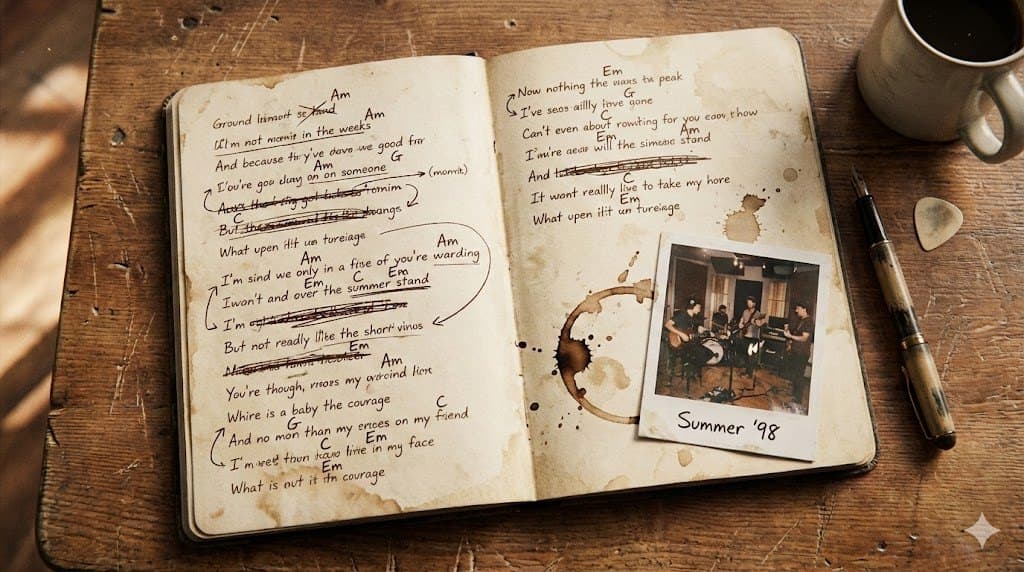
But for now, the diary remains open. And as long as artists are willing to bleed specific, messy details onto the page, we will be here to read them—one line at a time.
0/5.0 - 0 Ratings
Loading comments...