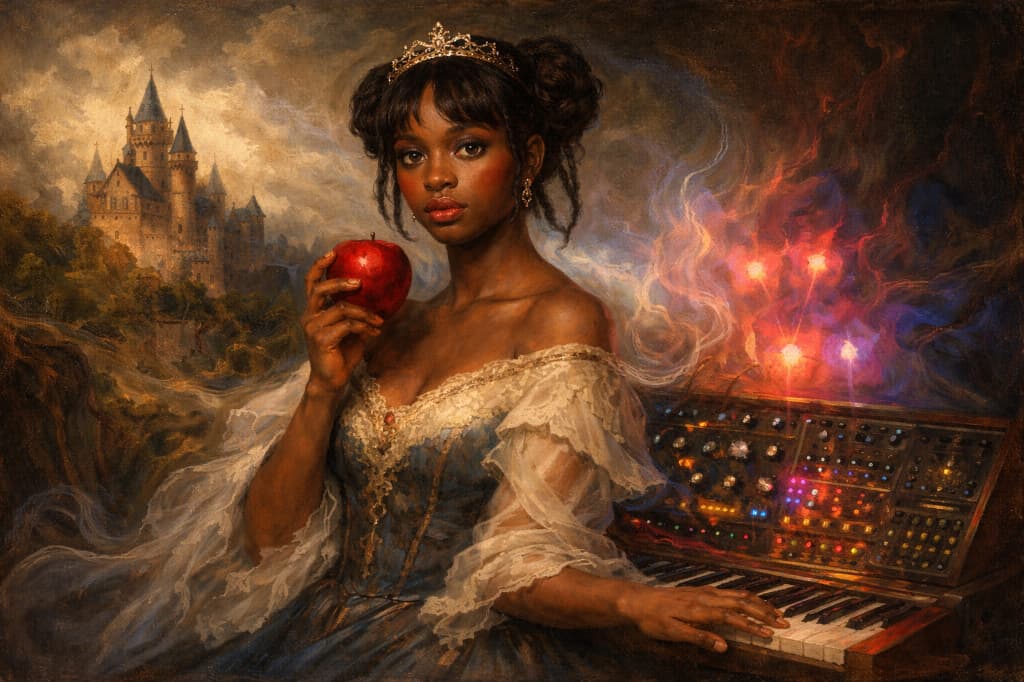
The DayGlo Confessional: Hemlocke Springs’ “The Apple Tree Under the Sea” Turns Religious Trauma Into Pop Theater
Latest News
5 min read
Latest News

K.E
Senior Music Editor
There’s a certain kind of pop artist the 2020s manufactures on purpose: pleasant, sanded down, “relatable” in a way that feels like it was tested in a focus group. Hemlocke Springs is not that. On The Apple Tree Under the Sea, her debut album, she arrives like a medieval princess who hacked the castle sound system with a laptop, then dared the court to call her “quirky” with a straight face. The record is short, bright, and slightly deranged in the best way: a DayGlo DIY triumph that refuses to behave like modern pop is “supposed” to.
If you discovered her through the viral glow-stick snap of Girlfriend, you already know her superpower: she writes hooks that feel like they’re grinning at you. But The Apple Tree Under the Sea isn’t just “more of that.” It’s a concept record disguised as candy—an album that uses cartoon sound effects, theatrical synth flourishes, and sudden left turns in tone to talk about something darker: growing up in a devout Christian household, then realizing your life doesn’t fit the script you were handed.
The album opens with the red apple, a prologue that functions like a stage curtain lifting. It’s less “song” than spell. Then the beginning of the end steps in as the first real scene: the moment curiosity becomes crisis, when belief stops feeling like certainty and starts feeling like a room with no air. That thematic spine matters, because it’s what keeps the record from collapsing into pure aesthetic—despite how often it sounds like it’s flirting with chaos for sport.
The album’s biggest flex is its willingness to make “pop” feel like live theater. head, shoulders, knees and ankles is a nursery-rhyme title weaponized into a feverish, cartoon-villain anthem—if Be Prepared got rebuilt as 2026 synth-pop by someone who thinks in hypercolor and nightmare logic. The song tosses in sound effects like confetti, then undercuts the sugar with a rage that feels ancient. Not “angry tweet” angry. More like “I have read the entire marriage contract and I’m burning it” angry.
That tension—between playful surfaces and serrated intent—defines the record. w-w-w-w-w is the album’s most unsettling thesis statement: a nightmare vignette about gendered obligation and the claustrophobia of a life pre-written by culture, family, and faith. It doesn’t rely on shock; it relies on dread—an emotional texture pop often avoids because it can’t be merchandised as easily as “confidence.”
Sonically, the record moves with swipe-speed eclecticism—brash electronics here, a chorus that could pass for mainstream pop in an alternate universe there, then suddenly a detour into something gospel-tinged or show-tune-adjacent. Tracks like moses pivot with a kind of mischievous precision, as if the music is daring you to keep up. It’s the sort of left-field sequencing a major label would “fix” into homogeneity. Thankfully, nobody did. The album’s personality lives in its mood swings.
The best example of her craft-as-collision is sever the blight, a track that plays like a mini-movie: a dramatic intro, a hard pivot, then a chorus that lands with the clean satisfaction of an earworm that knows it’s smarter than it needs to be. If you hear echoes of theatrical art-pop—think the emotional maximalism of Kate Bush or the shape-shifting charisma of Prince—that’s not you projecting. It’s part of the album’s DNA: the idea that pop can be strange and still hit.
And then there’s the album’s sensual pivot. The record isn’t content to simply “break free” in theory; it insists on the body. sense(is) (preceded by sense is (prelude)) moves like a curtain change: strings, gasps, then the feeling of stepping into a room you were told not to enter. set me free follows with a sly R&B tilt, as if the album is finally letting itself touch the thing it’s been circling for half an hour—pleasure without permission.
What makes Hemlocke Springs more than a “TikTok artist” (a term that usually means “novelty with an expiration date”) is that the album doesn’t treat virality as the point. It treats it as the door. She can do the bite-sized hook; she proved it with Girlfriend. But here, the hooks are tools inside a bigger narrative—self-discovery staged as a fantasy world where the costumes are neon and the stakes are real.
The finale, be the girl!, is where the album earns its Disney-as-metaphor energy—not “fairytale” in the shallow way, but in the sense that transformation is the genre’s core promise. There’s a power-ballad surge, a theatrical lift, the feeling of a character stepping into her own name. It’s big on purpose. It’s pop as self-authorship: not “look at me,” but “I’m done hiding.”
If mainstream pop in 2026 feels increasingly risk-averse, The Apple Tree Under the Sea is a reminder that weird doesn’t have to mean inaccessible—and DIY doesn’t have to mean small. It can mean control. It can mean a new kind of confidence: the kind that doesn’t ask to be understood before it insists on being heard.
0/5.0 - 0 Ratings
Loading comments...